Verdict
BitMEX created the instrument the whole category now trades and then lost the market to venues that did not have a DOJ case attached. The engine is still good. The liquidity, the product velocity and the reason to be here are not.
- Best for
- Inverse-contract traders with a specific reason to be here
- Cost
- -0.01% maker rebate / 0.075% taker on perps
What works
- Maker rebate rather than a maker fee on the flagship contracts
- Inverse (coin-margined) contracts remain well built and well documented
- Insurance fund is published and its full history is auditable
- No customer funds lost across a long and eventful history
What does not
- Liquidity is a fraction of what it was and thin outside the flagship pairs
- 2020 US enforcement action ended with guilty pleas and $100m in penalties
- Product development has lagged the category badly
- Withdrawal processing has historically been batched rather than continuous
The perpetual swap — no expiry, funding payments to hold the contract near spot — was invented here. Every venue in this category trades a variant of it. For a few years around 2018 and 2019, BitMEX's XBTUSD contract essentially was the crypto derivatives market, and the funding rate on it was a macro indicator people quoted in isolation.
Reviewing it now means separating that history from the current product, which is a smaller thing.
The fee structure, which is still good
The flagship perpetual contracts pay a maker rebate of around 0.01% and charge 0.075% taker. A rebate rather than a fee for posting liquidity is unusual at this point in the cycle, and for a passive quoting strategy it is genuinely attractive — you are paid to be there.
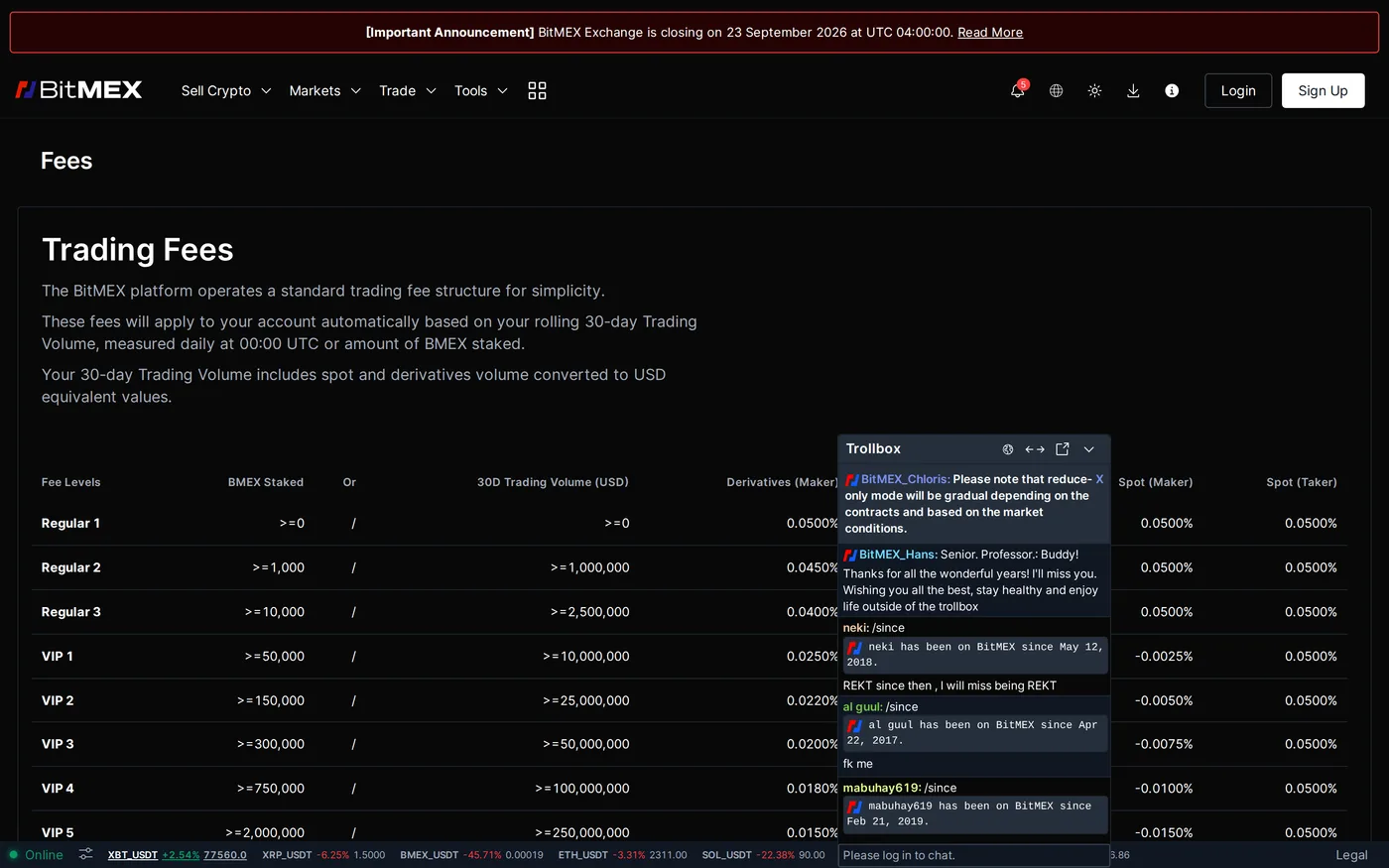
The taker rate is high against the category — Hyperliquid, dYdX and every large centralised venue undercut it substantially. The schedule is designed to attract quoting and to charge aggression heavily, which was a sensible design in 2017 when liquidity was scarce and is a hard sell now that it is not.
Inverse contracts
BitMEX's coin-margined contracts are margined and settled in crypto, which makes the payoff non-linear in dollar terms. That is a feature for a specific reader: a miner or a long-term holder hedging BTC exposure using BTC as collateral, without touching stablecoins at any point in the trade.
The documentation on these is still among the clearest anywhere, including worked examples of exactly how the non-linearity bites at different price levels. If you want to understand inverse contracts, read the BitMEX docs even if you intend to trade somewhere else.
The enforcement action
In 2020 the DOJ and CFTC charged BitMEX's operators over the failure to implement an anti-money-laundering programme. The founders pleaded guilty, and the company paid $100 million in penalties. KYC became mandatory, and a substantial part of the user base left rather than complete it.
The company survived and now runs as a compliant offshore venue with a real compliance function. But the volume went to Binance, Bybit, OKX and eventually to on-chain venues, and it has not come back. Liquidity is a network effect, and network effects do not reverse because the underlying problem was fixed.
What that leaves
Flagship pairs still have workable depth for retail size, and the engine itself is fast and stable.
Anything outside them has spreads wide enough to make the maker rebate irrelevant.
New products arrive slowly, and the interface has been refreshed rather than rebuilt.
The insurance fund is published with full history, which is more transparency than most competitors offer.
The documentation is the lasting contribution
BitMEX's explanations of funding, inverse contracts, liquidation and auto-deleveraging remain the clearest published anywhere, and they were written for traders rather than for a compliance file. A large share of what the market collectively understands about perpetual swaps came from this company's documentation and research blog.
That is not a reason to trade here. It is a reason to read the docs before trading anywhere, and it is the most durable thing the venue produced.
Verdict
The insurance fund, and why it is worth reading
BitMEX publishes its insurance fund balance with full history. The fund absorbs the shortfall when a liquidation cannot be closed at a price that covers the position, and when it is exhausted, losses are socialised across profitable traders through auto-deleveraging.
Most venues run the same mechanism and disclose considerably less about it. Reading BitMEX's history tells you how often the system has been stressed and by how much — information that applies to the whole category and that you simply cannot obtain elsewhere.
Auto-deleveraging, explained once
If you are profitable and highly leveraged, and the insurance fund cannot cover a counterparty's loss, the system may close part of your winning position to balance the book. You did nothing wrong and the trade was correct; the position closes anyway.
Every perpetuals venue in this library has some version of this. BitMEX documents its queue and its ranking rules openly, which is the only way to know in advance how exposed you are. If you trade perpetuals anywhere and have never read an ADL explanation, read this one.
Score: 6.5. A well-engineered venue with an honest insurance fund, a clean record on customer funds, and no compelling reason to choose it over Deribit for options, Hyperliquid for on-chain perps, or a large centralised venue for depth. Worth an account if the maker rebate genuinely fits your strategy; not otherwise.