Verdict
dYdX moved to a standalone chain specifically so no company would run the order book, and paid for that decision in liquidity. The result is a technically honest, genuinely decentralised perpetuals venue that is no longer the most liquid one.
- Best for
- Traders who want a validator-run order book
- Cost
- 0.01% maker / 0.05% taker at base tier
What works
- Order book is operated by validators, not a company
- Fee revenue is distributed to stakers rather than a corporate treasury
- Maker fees at the base tier are among the lowest available anywhere
- Long operating history with no loss of user funds
What does not
- Liquidity has drifted to competitors since the v4 migration
- Onboarding requires bridging and a chain most users have never used
- Not available to US persons
- Governance participation is concentrated among large holders
The decision that defines it
Earlier versions of dYdX ran the order book off-chain on infrastructure the company controlled and settled trades on Ethereum. It worked well, it was fast, and it was — by any honest definition — a centralised exchange with on-chain settlement.
v4 threw that out. The order book now runs in the memory of a validator set on a purpose-built Cosmos chain. No company operates matching. No company can halt your position or change the rules of a market mid-trade. The trade-off was accepted knowingly: worse latency than a co-located engine, a harder onboarding path, and a real risk that traders would simply go elsewhere.
They partly did. That is the honest summary of the two years since.
Fees and rewards
Base tier is 0.01% maker and 0.05% taker, stepping down with volume. The maker rate is competitive with anything in the category, decentralised or not, and for a quoting strategy it is one of the best numbers in this library.
Trading fees flow to validators and stakers rather than to a company's revenue line. Whether that matters to you as a trader is philosophical; whether it matters to the protocol's sustainability is practical, and so far the answer has been yes — the chain has continued to secure itself without external subsidy.
What using it is actually like
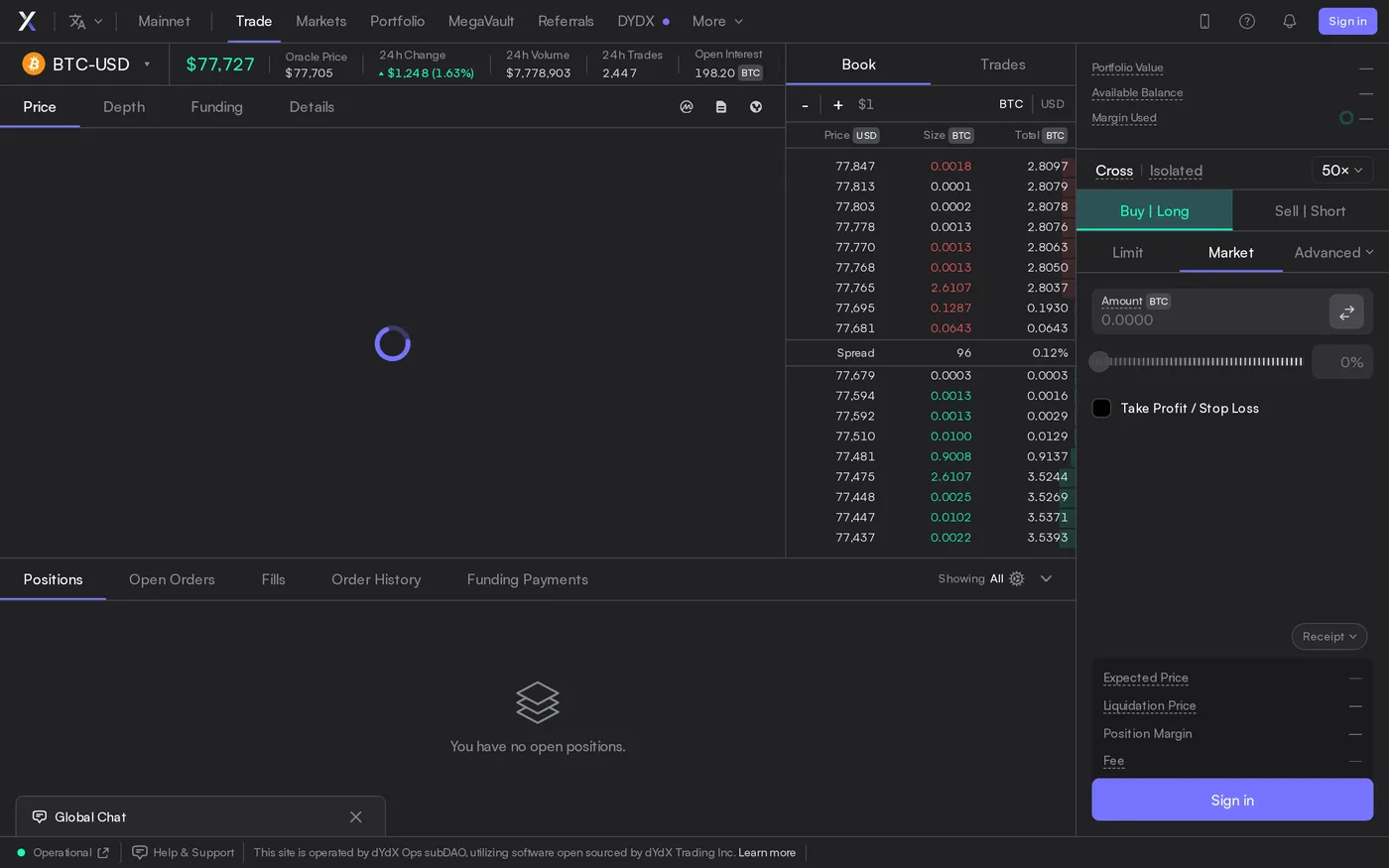
You bridge USDC onto the dYdX chain, connect a wallet, and trade. The interface is a standard perpetuals terminal — depth, positions, funding, order types, margin display. Once you are in, the experience is unremarkable in the good sense: nothing surprises you.
Getting in is the friction. Bridging to a chain you do not otherwise use, holding a gas asset you do not otherwise want, and reversing all of it to leave. For a trader who moves between venues weekly, that overhead is real and it compounds.
Liquidity, plainly
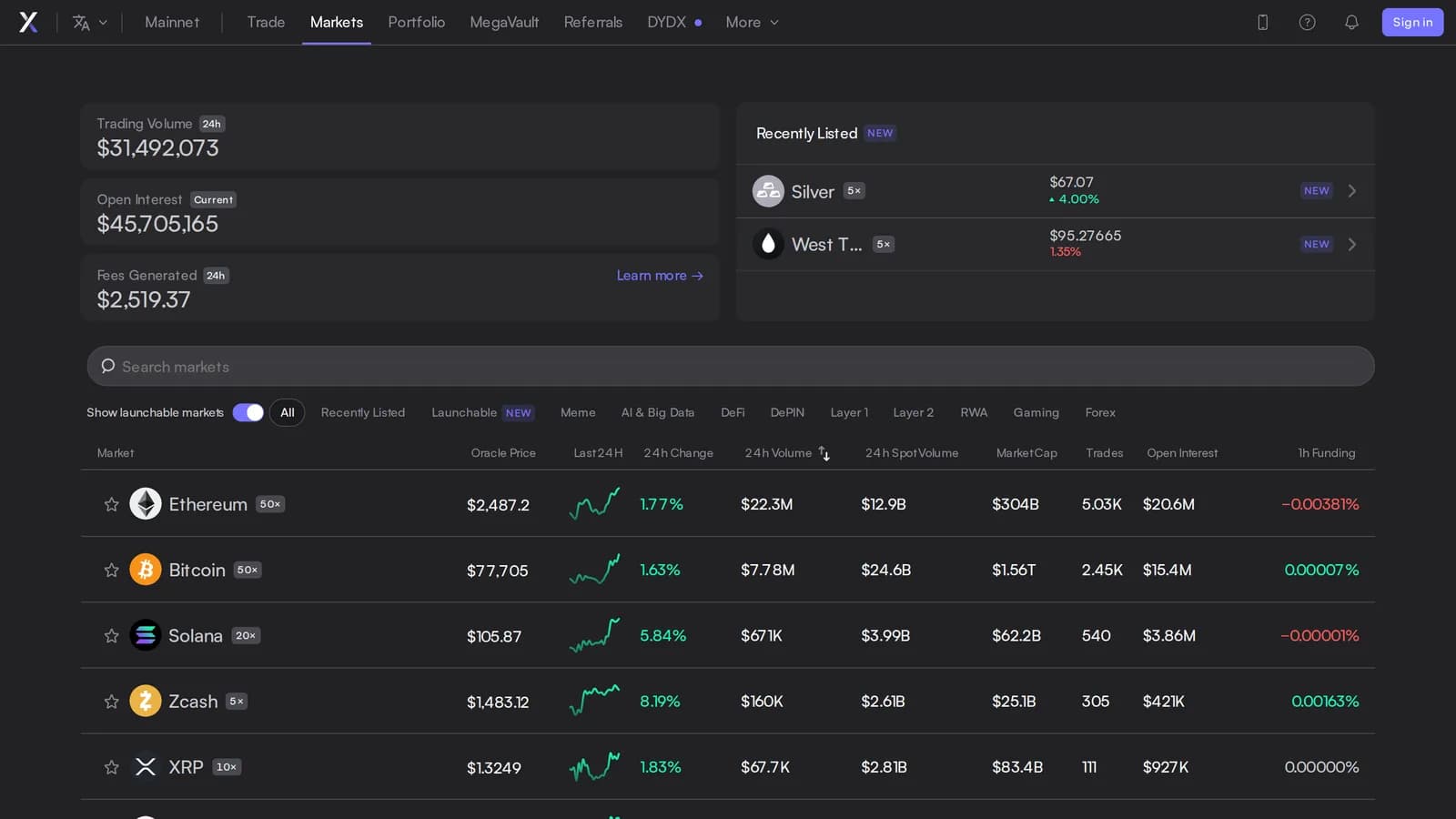
On BTC and ETH perpetuals, books are adequate for retail size. Against Hyperliquid's depth or a large centralised venue's, they are not close, and on the longer tail of listed markets the spread tells you so immediately.
This is the cost of the architecture rather than a failure of execution. A validator-run order book cannot match a co-located engine on latency, and professional market makers price latency risk into their quotes. No amount of protocol improvement removes that gap entirely.
Governance
Protocol changes go through token-holder governance, and participation is concentrated among large holders in the way it is on every such system. Calling it decentralised governance is accurate in mechanism and generous in practice — a handful of addresses can carry most votes, and the proposals that matter are usually settled before they reach a formal vote.
How it compares
Against Hyperliquid: dYdX is more genuinely decentralised and noticeably thinner. Against a centralised venue: cheaper on the maker side, harder to reach, and immune to the withdrawal-freeze risk that defines the category.
Verdict
What you get that a centralised venue cannot offer
Nobody can freeze your collateral. There is no compliance department with a button.
Nobody can halt trading in a market because the outcome is inconvenient for the protocol's treasury.
The order book state is reproducible from chain data, so a disputed fill is a question of fact rather than a support ticket.
There is no withdrawal queue, because there is no withdrawal — the assets are in a chain account you control.
Those properties sound abstract until the week a venue you use decides to pause withdrawals. This is what you are paying for in worse fills, and whether it is worth the trade is a genuine question rather than a rhetorical one.
The security record
Across several versions and years of operation, dYdX has not lost user funds to an exploit — a record very few DeFi protocols of comparable age and value can claim. The v4 architecture removed the bridge and smart-contract surface that produced most of the category's incidents, replacing them with the validator assumptions of a Cosmos chain.
That is a different risk, not the absence of risk. A chain with a small validator set has its own failure modes, and dYdX's security now depends on the economics of its staking set rather than on the correctness of a set of contracts.
Score: 7.7. A protocol that did the difficult version of what its peers claim to do, with clean pricing, a clean security record and a real cost in liquidity. Choose it when the property you want is that nobody can stop your trade; choose Hyperliquid when the property you want is a fill.