Verdict
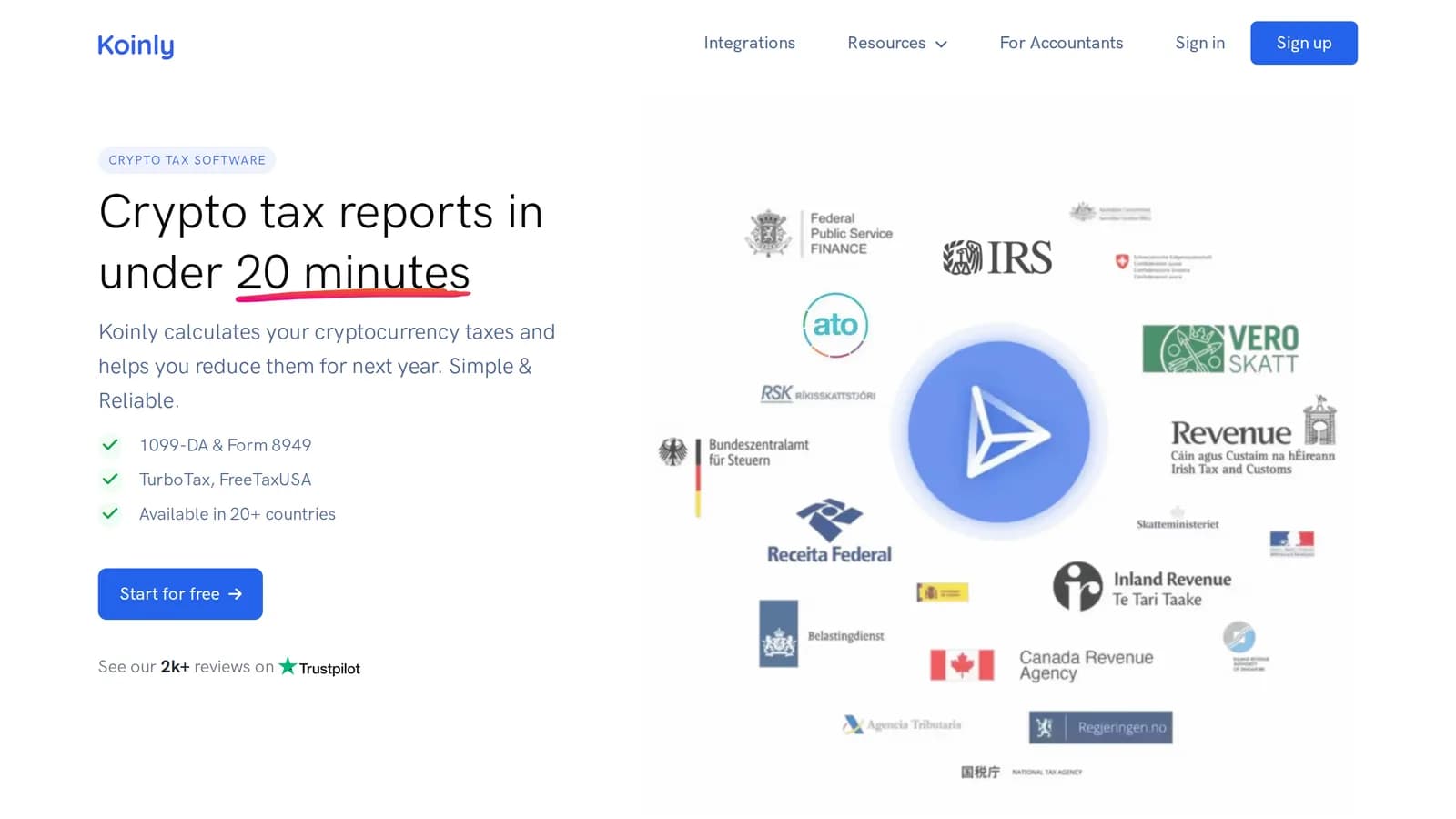
The widest jurisdiction coverage in crypto tax software, with free tracking and payment only when you download a report. If you are not American, this is almost certainly the answer.
- Best for
- Non-US filers and multi-country portfolios
- Cost
- Free to track; reports from ~$49 per tax year
What works
- Supports local report formats for more than twenty countries
- Free until you download — you can verify the numbers before paying
- Very large library of exchange, wallet and chain integrations
- Cost-basis method selection is explicit and jurisdiction-aware
What does not
- Pricing is per tax year, so back-filing several years multiplies the cost
- Transaction tiers mean a few thousand DeFi interactions push you up a bracket
- Complex DeFi positions still require manual classification
- Exchange API imports occasionally miss internal transfers and need reconciling
Crypto tax software has a structural problem: tax law is national, and most of these products were built for one country and then internationalised by adding a currency dropdown and a disclaimer. Koinly is the clearest exception, and it is the reason it wins this category.
It produces the actual forms and formats different tax authorities expect — UK capital gains summaries, Australian schedules, US Form 8949, Swedish K4, and more than twenty others. For anyone outside the US, that is the difference between a usable report and a spreadsheet you still have to translate into your own tax authority's language.
The pricing model is the best thing about it
Tracking is free. You connect every exchange and wallet, let it import your history, review the classification, and fix what is wrong. You pay only when you want to download a finished report.
That ordering matters enormously. You can verify the numbers are right before spending anything, which is the opposite of the usual arrangement where you pay first and then discover the import mangled your transfers between your own wallets.
Report pricing starts around $49 for a small number of transactions and rises through tiers to a few hundred dollars for high-volume accounts, per tax year. Back-filing three years means paying three times, and there is no bundle that makes that cheaper.
Integrations and where they leak
The integration library is large: hundreds of exchanges, wallets and chains, via API, CSV upload and public address watching. Coverage is not the problem and has not been for years.
Reconciliation is. The recurring failure modes are consistent across every tool in this category:
Transfers between your own accounts get read as a disposal and a purchase, inventing a taxable event that never happened.
Exchange APIs that do not expose full history leave gaps that silently change your cost basis.
A missing cost basis on an early acquisition defaults to zero, inflating your reported gain enormously.
An exchange that shut down cannot be re-imported, so those records have to come from whatever you kept yourself.
Koinly flags most of these with warnings rather than quietly producing a confident wrong number, which is the correct behaviour and still requires you to work through the list carefully.
No crypto tax tool is accurate out of the box. The good ones tell you where they are unsure; the bad ones give you a total.
DeFi
Straightforward swaps, staking rewards and liquidity positions are handled competently. Anything genuinely complex — a leveraged position unwound through three protocols, a bridged asset that changed representation, a rebasing token, an NFT bought with a borrowed asset — needs manual classification, and the interface for doing that is workable rather than pleasant.
Budget real time for this if your on-chain activity was anything more than swapping. The software will get you 90% of the way and the last 10% is the part that determines whether the number is right.
Cost basis
Methods are selectable and defaulted according to jurisdiction — FIFO, average cost, share pooling where the local rules require it. That sounds like a technical detail and it changes your bill materially.
Confirm the selected method matches what your tax authority actually mandates rather than what produces the nicest number. Choosing the flattering option is a decision you will have to defend later.
How it compares
Against CoinTracker: cheaper at equivalent volumes and far better outside the US. Against CoinLedger: broader jurisdiction support, similar price. Against doing it in a spreadsheet: not a real comparison once you have more than a few dozen transactions.
Verdict
Working through it efficiently
Connect every source before classifying anything. A transfer only reconciles when both ends are present.
Start with the oldest year. Cost basis flows forward, and fixing 2019 fixes everything after it.
Work the warnings list top to bottom rather than browsing transactions — the warnings are where the errors are.
Tag your own wallets as yours explicitly, rather than relying on automatic detection.
Export a copy of the final data as well as the report. Next year you will want last year's closing positions.
A first reconciliation on a genuinely messy history takes a weekend. Every subsequent year takes an hour, because the hard part was establishing the basis rather than producing the form.
What it costs you to leave this late
Exchanges delete or restrict API history. Platforms shut down. A wallet you have not opened in three years may need a seed you have to go and find. Every year you postpone reconciliation, the data gets harder to assemble and more of it has to be reconstructed by hand.
Because tracking is free, there is no financial reason to wait. Connect everything now and pay for the report when you need it — the value is in having done the import while the data still exists.
Score: 8.2. The best crypto tax product for anyone outside the US, with a pricing model that letsyou check the work before paying for it. The per-year cost adds up for back-filing, and no software in this category removes the reconciliation work — it only makes it visible.