Verdict
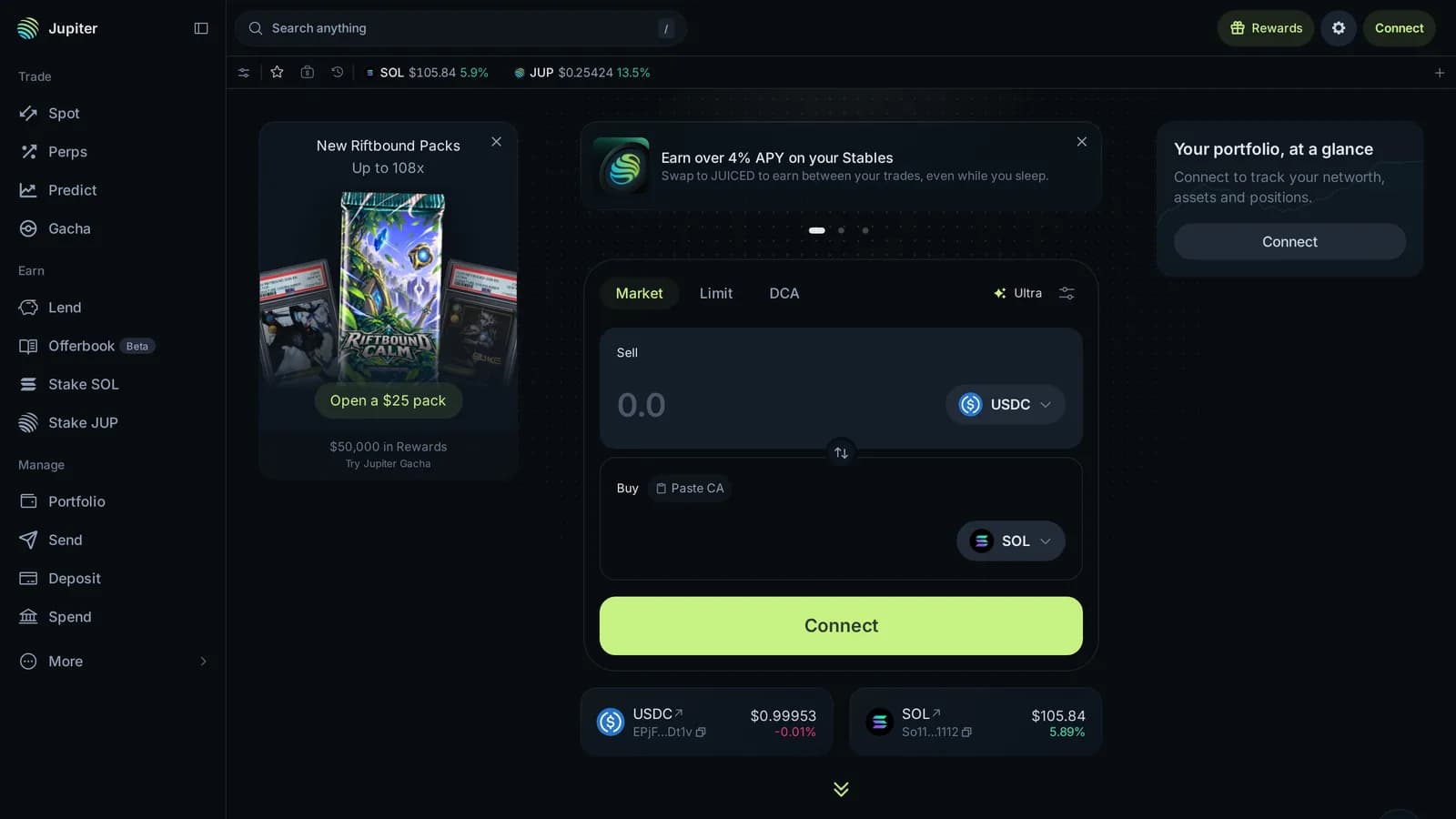
Jupiter aggregates every AMM on Solana and consistently finds a better price than going direct, without charging an aggregator fee. It has since become a perpetuals venue, a limit-order engine and a launchpad — and the routing is still the best thing about it.
- Best for
- Any swap on Solana
- Cost
- No aggregator fee on standard swaps
What works
- Routes across every meaningful Solana liquidity source, splitting across venues
- No protocol fee on standard swaps — you pay the underlying pool and network cost
- Limit orders and DCA are built in and execute on-chain
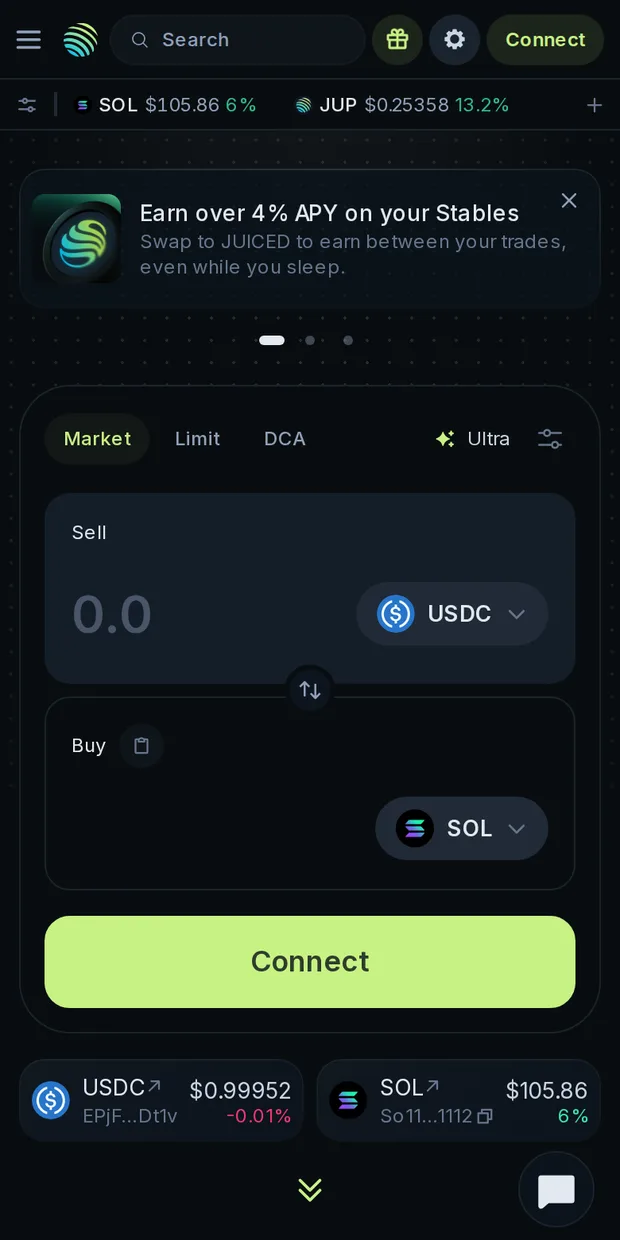
- Slippage and price-impact warnings are presented clearly before you sign
What does not
- Expanding product surface increasingly competes with the neutrality of the router
- Perps and launchpad carry risk profiles far removed from a simple swap
- Airdrop-driven usage makes historical volume figures hard to read
- Complex routes can fail during congestion and cost you a retry
Solana has a lot of AMMs. Raydium, Orca, Meteora, Lifinity, and a long tail beyond them, each with different depth on different pairs at different moments of the day. Choosing between them manually is a waste of time, and choosing wrong costs real money on every trade.
Jupiter's original product solved that: it reads every venue, splits the order across whichever combination gives the best net price, and executes it in a single transaction. It is now the default swap path for most of the chain, and deservedly so.
What it costs
For standard swaps, Jupiter charges no aggregator fee. You pay the fees of the underlying pools it routes through and Solana's network cost, which is fractions of a cent.
That is unusual and worth stating plainly, because the comparison point — Uniswap's own front end taking up to 0.25% — is right there in the same category. Jupiter monetises through its other products rather than by taxing the router, and the difference on a $10,000 swap is $25 you keep.
Routing quality
The router splits across venues rather than picking one, which matters most exactly when it is hardest: large orders on mid-liquidity tokens. A $50,000 swap that would move a single pool several percent gets divided across four, and the difference in realised price is usually larger than any fee you were comparing in the first place.
It also surfaces price impact prominently before you sign. Several competitors bury that number two panels deep, and it is the most important figure on the screen for anything outside the majors.
Everything else it now does
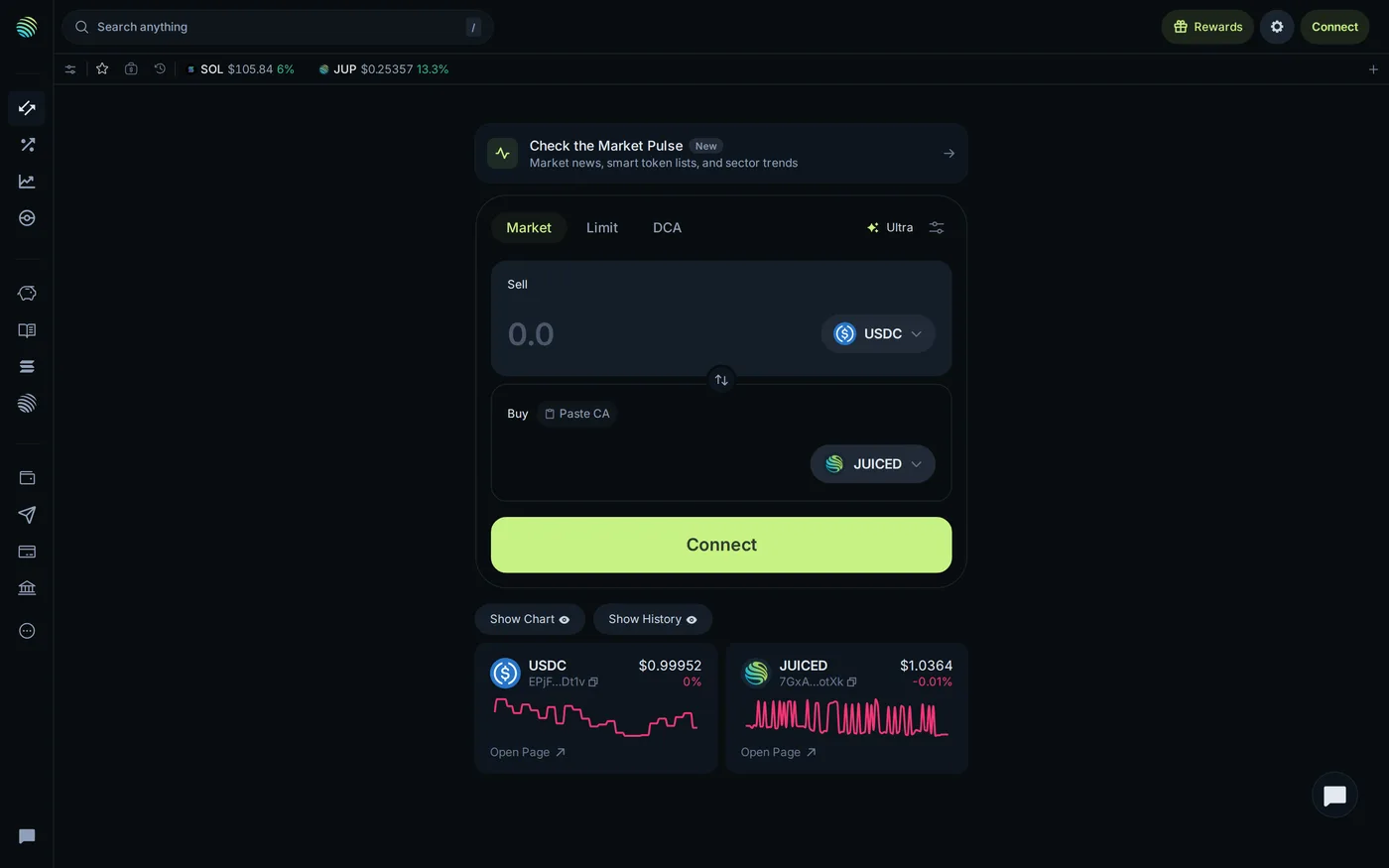
Limit orders that sit on-chain and execute when the price is reached, without a centralised order book holding your funds.
DCA, splitting a purchase across a schedule to reduce impact — genuinely useful for large positions in thin tokens.
Perpetuals, an oracle-priced leveraged product with its own liquidity pool and its own risk profile.
Launchpad and token-launch tooling, which is a different business entirely and should be evaluated as one.
The neutrality question
An aggregator's value is that it has no stake in where your order goes. As Jupiter adds its own markets, its own launch platform and its own token economy, that neutrality becomes something users take on trust rather than something guaranteed by the design.
There is no evidence of routing being biased towards its own venues, and the routing logic is observable in the transaction itself. But the incentive now exists where it previously did not, and that is worth watching rather than assuming away.
A router that runs its own markets is not automatically compromised. It is just no longer structurally disinterested, and that is a change in what you are trusting.
Practical notes
During heavy congestion, complex multi-venue routes fail more often than simple ones. Jupiter handles retries reasonably, but if a swap is failing repeatedly, reducing the route complexity or the size clears it faster than raising the priority fee indefinitely.
Verdict
Limit orders and DCA, which are better than they sound
On-chain limit orders are genuinely useful on Solana in a way they are not on expensive chains: the order sits on-chain, executes when the price is reached, and costs almost nothing to place or cancel. You are not leaving funds with a centralised venue to get a resting order.
DCA is the more underrated feature. Splitting a large purchase in a thin token across a schedule reduces price impact more effectively than any routing improvement can, and Jupiter's implementation lets you set the interval and the slippage tolerance per leg rather than accepting a preset.
The token and the airdrops
JUP's distribution was one of the largest airdrop programmes in the chain's history, and a meaningful share of Jupiter's historical volume was farming activity rather than organic demand. Anyone comparing volume figures across periods should account for that before drawing conclusions about growth.
This does not affect the quality of the router, which is what this review scores. It does mean the usual caution applies to reading the protocol's metrics as evidence of product-market fit.
Score: 8.4. The best routing layer on any chain, offered without an aggregator fee, with clear risk disclosure at the point of signing. This score reflects the swap product; the perpetuals and the launchpad are separate propositions that deserve separate scepticism.