Verdict
HTX still runs real books on major pairs and a fee schedule that is competitive on paper. The governance history, the concentration of influence around a single high-profile backer and the thin disclosure make it a venue for traders who can afford to be wrong about their counterparty.
- Best for
- Traders already holding HT with a high risk tolerance
- Cost
- 0.20% base spot, lower with HT and VIP tiers
What works
- Genuine liquidity on BTC, ETH and the large-cap USDT pairs
- Fee ladder is aggressive for holders of the platform token
- Long operating history with continuous spot markets since 2013
- Publishes a reserve ratio page for the main assets
What does not
- Governance is dominated by one publicly associated individual
- Disclosure around entity structure and legal domicile is thin
- Withdrawal issues have recurred during stressed periods
- Support and documentation quality is well below the category median
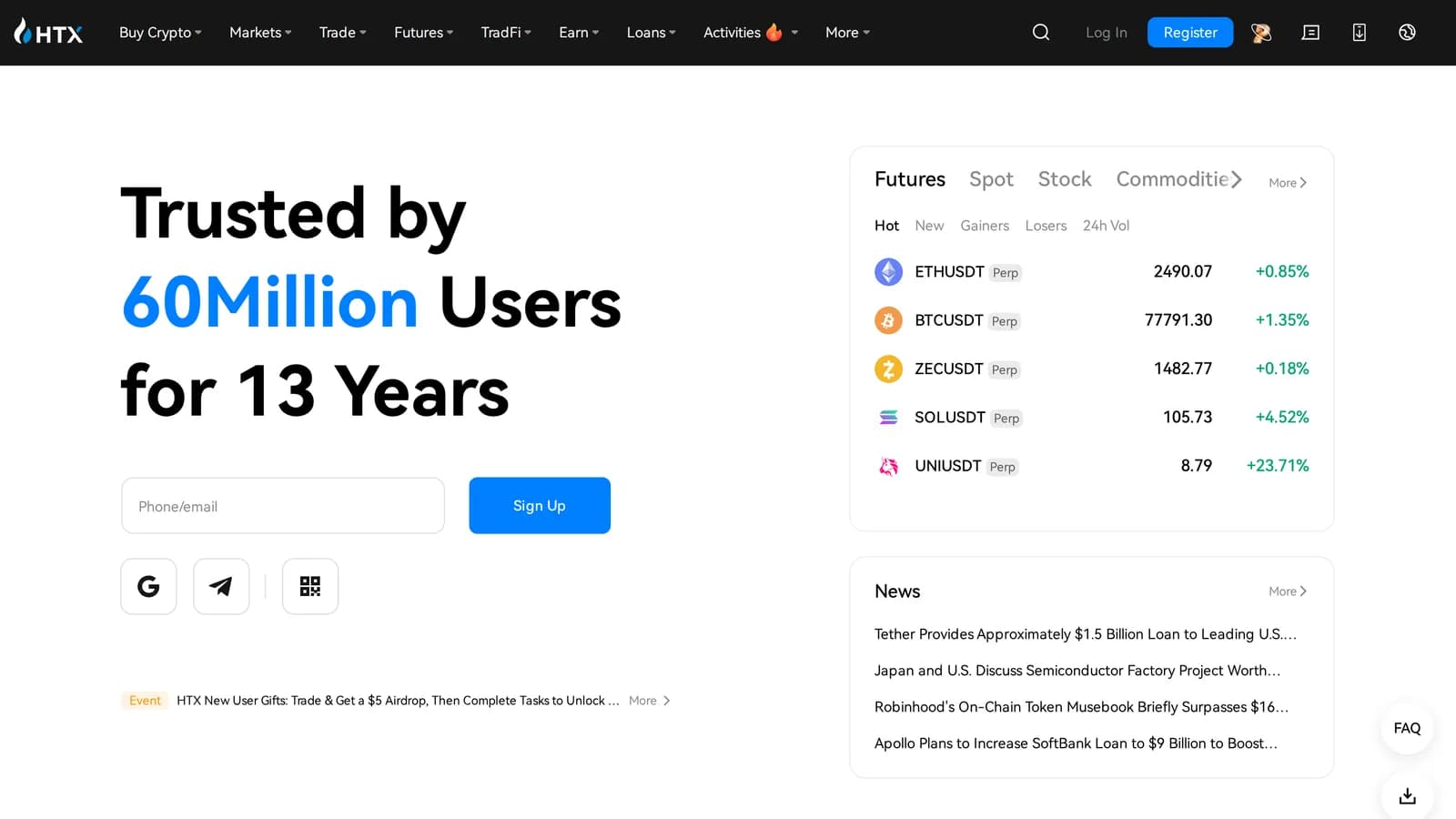
HTX — the exchange formerly known as Huobi — has been trading continuously since 2013, which in this industry makes it ancient. Longevity usually earns a venue the benefit of the doubt. Here it does not, and it is worth being precise about why rather than gesturing at reputation.
The parts that work
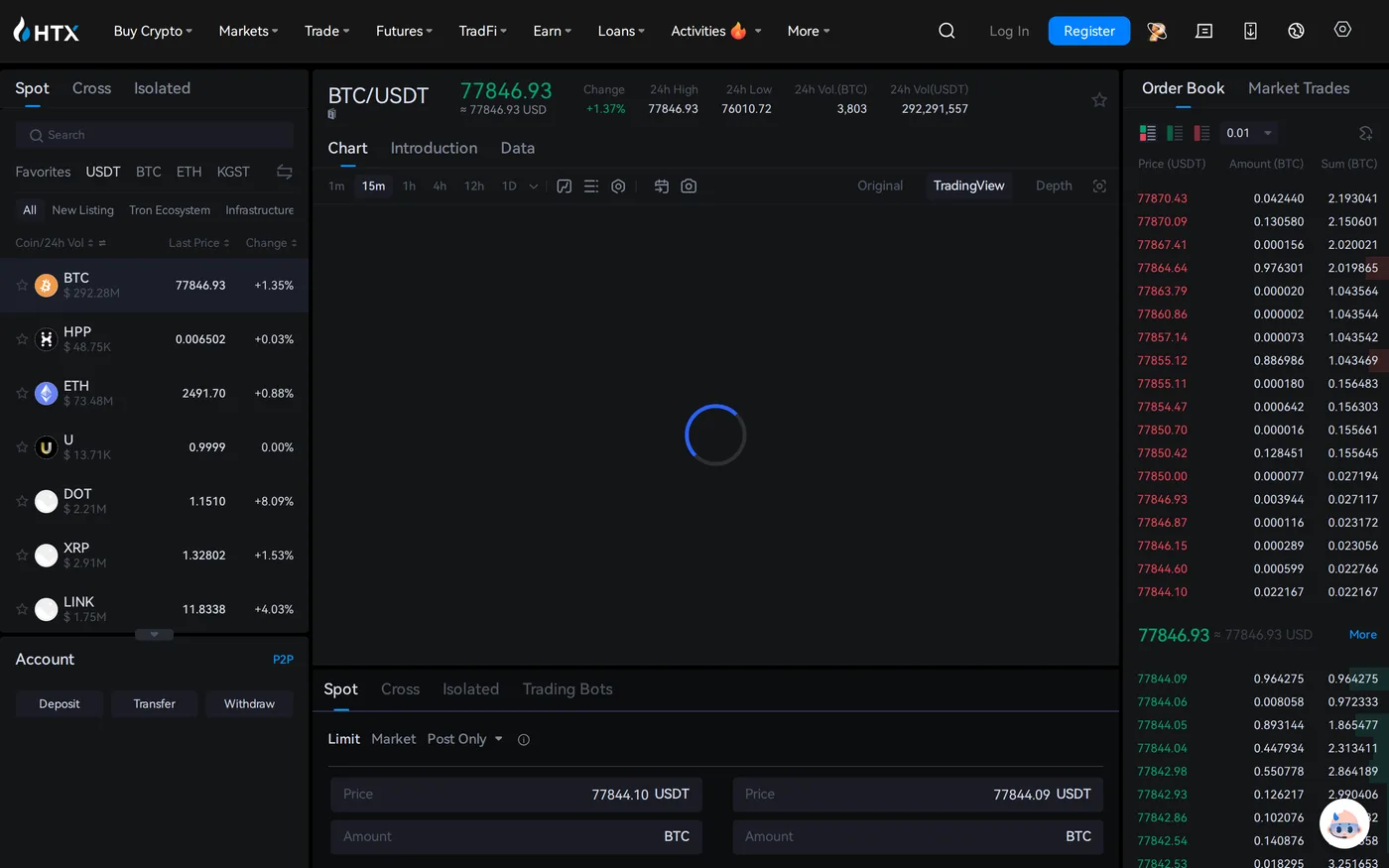
Liquidity on the major USDT pairs is real. BTC/USDT and ETH/USDT have books deep enough to absorb a five-figure market order without a visible print, and the derivatives side maintains open interest that does not look manufactured. For a venue that has been written off repeatedly over the last four years, it has retained considerably more volume than its reputation suggests.
The published spot schedule starts around 0.20% for both sides at the base tier, with a ladder that falls steeply for holders of the platform token and for volume tiers. If you already hold HT, the effective rate is competitive with anything in this category. If you do not, the base rate is twice Binance's and you are getting less for it.
The parts that do not
The governance question is unavoidable. A single high-profile figure is publicly associated with both the exchange's direction and several of the assets that trade heavily on it. Whatever your view of that individual, concentration of that kind is a structural risk: the venue's fortunes, its listing decisions and its treasury become correlated with one person's other ventures, none of which you can see.
Disclosure is thin in exactly the places that matter. A reserve ratio page exists, but the methodology behind it is documented far less thoroughly than at Binance, OKX or Kraken, and there is no client-side verification path with comparable rigour. Which legal entity you are contracting with, and where a dispute would be heard, is not clearly presented anywhere a normal user would look.
An exchange that will not tell you clearly who it is does not get the benefit of the doubt about where your coins are.
Withdrawals
Withdrawal friction has recurred during stressed periods — delays, temporary suspensions of specific assets, and explanations that arrive after the fact. Each individual incident has an ordinary technical explanation, and most have been resolved within days.
The pattern is what should inform your decision rather than any single event. A venue where withdrawals occasionally stop is a venue where you should not be holding anything you would mind waiting for.
Support and documentation
Help content is fragmented across an older knowledge base and a newer one, with contradictions between them on things as basic as which networks are supported for a given asset. Support responses are slow and heavily templated, and escalation paths are unclear.
Fee changes and listing decisions are communicated through announcement posts that are easy to miss, and there is no reliable notification path for changes that affect an existing position.
Who, realistically, should use it
Traders who already hold HT and are capturing the fee discount they have effectively pre-paid for.
Arbitrage desks who move in, trade, and move out within the same session.
Anyone trading a pair that has meaningful depth here and nowhere else — a list that has been shrinking for three years.
How it compares
Against MEXC, HTX has better depth on majors and comparable disclosure weakness. Against KuCoin, it is behind on both listing speed and post-settlement compliance rebuild. Against any of the top four venues in this library, it is not a serious comparison on custody clarity.
Verdict
Derivatives and the platform token
The derivatives product carries reasonable open interest on the major contracts and the funding mechanism behaves normally. Where it differs from better-run venues is disclosure: the insurance fund is reported but its history is harder to reconstruct, and the tiered margin table is less prominently published than at OKX or Deribit.
HT, the platform token, is the mechanism by which the fee ladder becomes competitive. That creates a familiar bind: to trade cheaply you must hold an asset whose value depends on the exchange's continued health, which is exactly the correlation you were trying to avoid by not leaving a balance there. Anyone using the fee discount is, by construction, running a leveraged bet on the venue.
What would change this score
A reserve attestation with published methodology and a client-side verification path.
A clear statement of which legal entity serves each jurisdiction, on a page a normal user can find.
Two consecutive years without a withdrawal interruption on any major asset.
Governance separation from the individual currently associated with the venue's direction.
None of those are unreasonable asks. Three of the four are things competitors already do, which is the point.
Score: 6.2. Not because the exchange does not work — it does, and the engineering is competent — but because the score in this library is weighted towards custody clarity and disclosure, and HTX is comfortably last among the large venues on both. Trade if you must, settle out the same day, and do not treat the longevity as reassurance.