Verdict
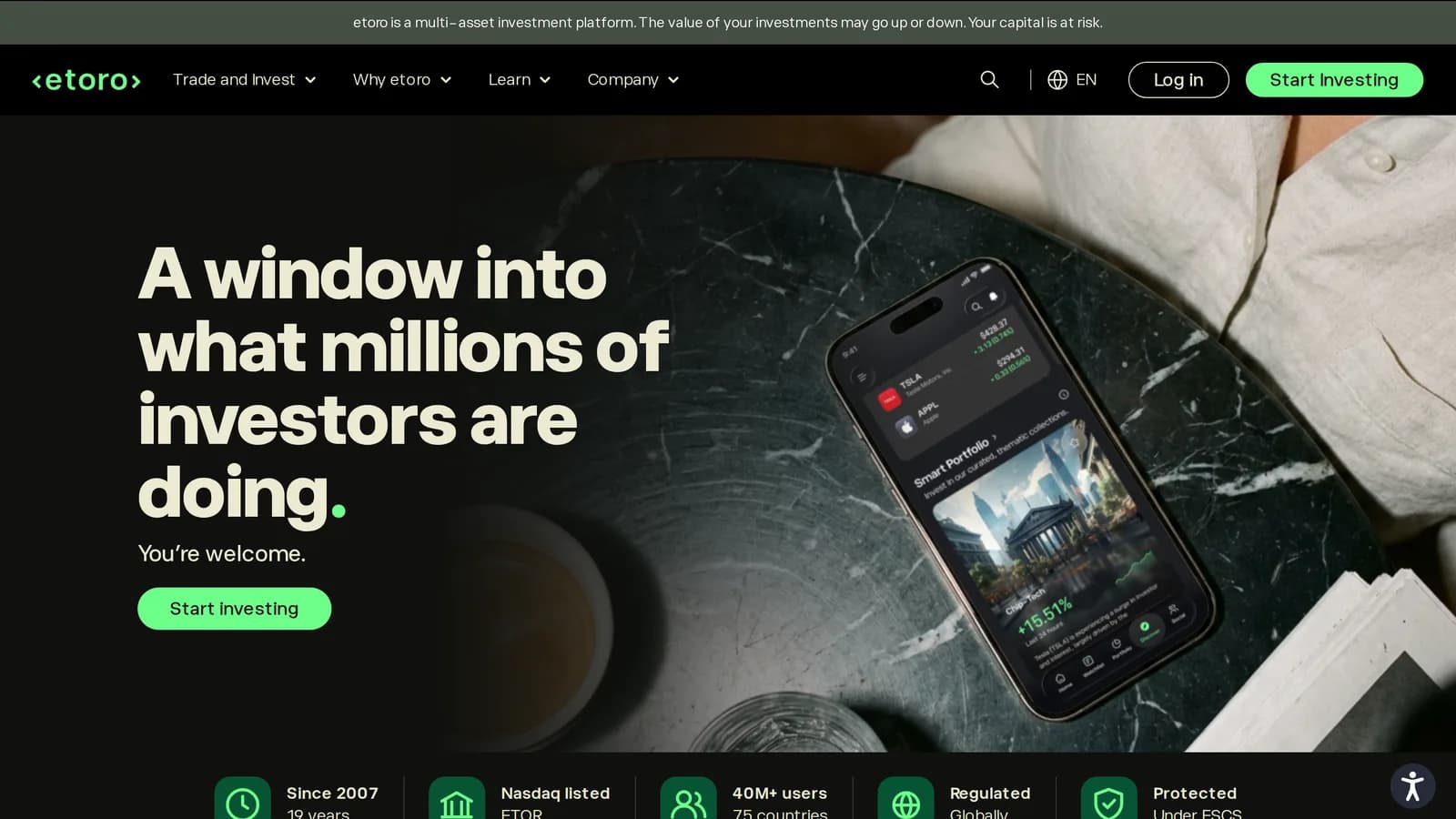
A well-regulated multi-asset broker with the most developed social trading product in the market, charging 1% on each side of a crypto trade. The copy trading is the draw and it is also the part most likely to cost you money.
- Best for
- Social trading across crypto and equities
- Cost
- 1% buy and 1% sell on crypto, plus spread
What works
- Regulated in multiple major jurisdictions with a listed parent company
- CopyTrader is the most polished implementation of social trading anywhere
- Crypto sits alongside equities, ETFs and commodities in one account
- Fee disclosure is clearer than most brokers manage
What does not
- 1% on both sides means a 2% round trip before any price movement
- $5 withdrawal fee and a monthly inactivity fee after twelve months
- Leaderboards select for survivors and reward high-variance strategies
- Crypto withdrawal support is limited compared with an exchange
eToro is a broker first and a crypto platform second, and it is unusually honest about its pricing for a firm in this business. The crypto fee is 1% on the buy and 1% on the sell, stated plainly in the fee documentation, on top of the market spread.
That is a 2% round trip. Before the price moves at all, a position must appreciate 2% for you to break even. On a large centralised exchange the equivalent figure is around 0.2%, and on a good one it is less.
What the 1% buys
Regulation in multiple major jurisdictions, with a listed parent company and published financial statements.
A single account holding crypto, equities, ETFs and commodities with unified reporting and a single tax document.
Customer protections that vary by region but exist in a way they simply do not on an offshore exchange.
The social layer, which is the actual reason most people are here.
That is a real list, and for a buy-and-hold investor putting 5% of a portfolio into Bitcoin once, 2% round trip on a position held for years is not the decisive factor. Whether it is worth it depends entirely on how often you trade — which is the tension at the centre of the product, because the social layer exists to make you trade more.
CopyTrader
You allocate capital to another user and your account mirrors their positions proportionally. The implementation is the best in the market: real historical data, risk scores, drawdown history, and the ability to stop copying at any point without a lock-up.
The statistical problems are not solved by good engineering.
The list you choose from contains survivors. Traders who blew up are not in it, and there is no way to see the denominator.
Risk scores are backward-looking. A trader who has been lucky and a trader who has been good look identical for a surprisingly long time.
Copying five popular traders during the same market regime gives you one concentrated position wearing five names.
The strategy you are copying may depend on capital, leverage or timing that your allocation cannot reproduce.
Copy trading solves the problem of not knowing what to buy by replacing it with the problem of not knowing whom to trust. The second problem is harder and the interface makes it look easier.
The other fees
A $5 withdrawal fee, a monthly inactivity fee after twelve months without a login, and currency conversion charges if your deposit currency differs from the account currency. Individually small, collectively the kind of arrangement that quietly erodes a small dormant account over a few years.
Crypto specifics
Withdrawal of actual coins is supported for a subset of assets to eToro's own wallet, with limits and conditions. This is a brokerage relationship, not an exchange account, and for most assets you are holding an entitlement rather than a coin you can move to an address you control.
If self-custody matters to you at all, this platform is structurally the wrong choice regardless of what the fee schedule says.
How it compares
Against Bitpanda: similar European retail positioning, eToro is more expensive and has the better social product. Against Bitget's copy trading: eToro costs several times more per trade and is regulated in a way Bitget is not. Against an exchange: not a real comparison — different product, different legal relationship.
Verdict
The regulated part is not decoration
eToro operates through separate regulated entities by region, and which one holds your account determines your protections — investor compensation schemes, complaint routes, segregation requirements. This is stated in the terms and almost never read.
It is worth reading. The difference between the European entity and the offshore one is not cosmetic, and for anybody choosing this platform specifically because it is regulated, knowing which regulator is the entire point of the decision.
What it is genuinely good for
Somebody who wants crypto as a small sleeve of a conventional portfolio and does not want a second platform for it.
A beginner who values a regulated environment and a support line over a low fee.
Anyone who wants to observe how discretionary traders actually behave — the transparency of the social feed is educational even if you never copy a position.
What it is not good for is anyone who intends to trade frequently, hold long-term in self-custody, or optimise for cost. Those three descriptions cover most people who read reviews like this one.
Score: 6.7. Well regulated, clearly priced and genuinely good at the social product. The cost onlymakes sense for someone who buys rarely and holds — which is precisely the opposite of the behaviour the platform is designed to encourage.